Contractor Estimate Template: Make the Price Easier to Understand
A customer shouldn't have to guess what your number includes. This worked estimate shows the scope, line items, exclusions, and next step that make a proposal easier to discuss.
On This Page
Two prices arrive. Only one explains the job
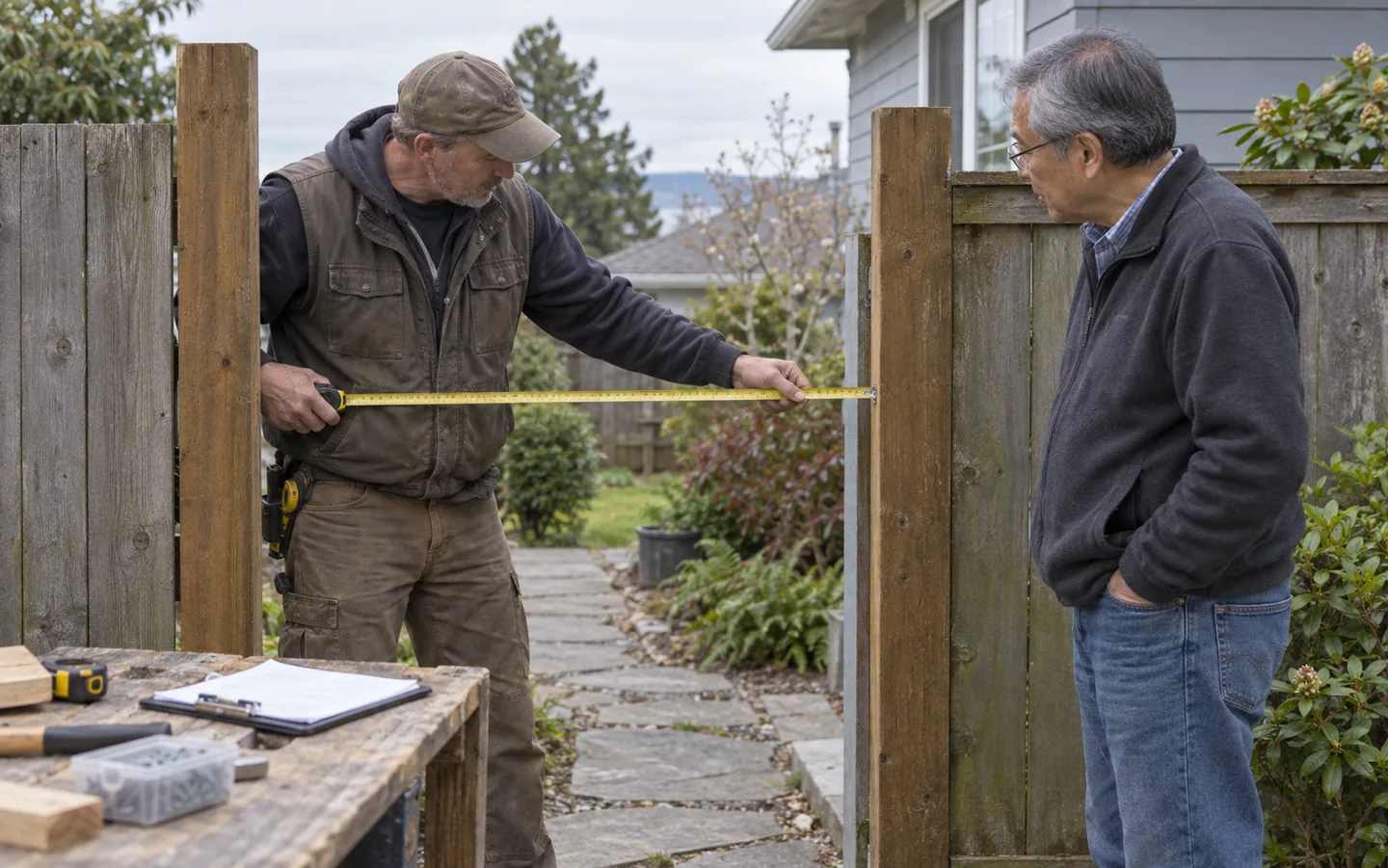
A homeowner receives two estimates for the same fence. One says “Replace fence: $4,500.” The other identifies the length, material, removal, gate, and what happens if the old posts conceal a problem.
The second estimate may still be more expensive. But the homeowner has a chance to understand the difference.
A contractor estimate template gives the price a repeatable structure: who the work is for, what is included, how the amount is built, which assumptions apply, and what happens next. It can't make uncertain measurements accurate or turn an incomplete scope into a reliable price.
The example below stays on the page. It is a worked explanation, with invented figures, rather than a claim about the cost of fencing in your market.
The estimate header should remove ambiguity
Before the line items, identify the company, customer, project location, date, and version. These details stop an old proposal or a similar property becoming the wrong reference point.
| Field | Worked example | Why it belongs |
|---|---|---|
| Estimate reference | EST-1042, revision 1 | Gives both parties a specific document to discuss |
| Prepared for | Jordan Ellis | Identifies the customer |
| Project location | Customer's confirmed property address | Separates the work location from any billing address |
| Work | Replace 60 linear feet of timber fence and one gate | States the project in recognizable terms |
| Prepared on | Date the estimate is issued | Establishes when the scope and price were prepared |
| Prepared by | Business name and contact details | Makes questions easy to direct |
| Price review point | The actual validity or review terms offered | Explains when a price needs checking again |
A revision needs its own identifier. If the customer changes the gate or the material, both parties should know which version they are considering. “The estimate I emailed you” becomes a poor description when three versions exist.
The line items should describe work, not hide it
Here is a deliberately simple structure. The amounts illustrate the arithmetic; they are not recommended rates or a pricing benchmark.
| Item | Quantity | Unit amount | Line amount |
|---|---|---|---|
| Remove and dispose of existing fence | 60 linear feet | $8 | $480 |
| Supply and install specified timber fence | 60 linear feet | $52 | $3,120 |
| Supply and fit one specified gate | 1 | $650 | $650 |
| Agreed finishing work | 1 allowance | $250 | $250 |
| Subtotal | $4,500 |
For this example, the installation rate includes the labor and materials described in that line. Adding another general labor charge for the same work would double-count it.
Taxes, where applicable, should be shown using the treatment and rate appropriate to the work and location. A universal template cannot determine that for every business. If the entire $4,500 subtotal were taxable at an assumed 8%, the illustration would add $360 and produce $4,860. That assumption must not silently become the rule for an actual estimate.
An allowance should explain what it covers and how the final amount is settled. Calling something an “allowance” without a basis merely moves the uncertainty to another line.
Write the scope underneath the numbers
A line item names the work. The scope explains it well enough for the customer and the crew to share the same understanding.
For the worked fence example, the scope could read as follows. These specifications belong to this example, not every fence installation.
| Part of the scope | Description in the example |
|---|---|
| Fence section | Replace 60 linear feet along the marked rear boundary |
| Specification | Six-foot timber fence using the agreed treated-timber specification |
| Gate | One three-foot-wide timber gate in the assessed opening, with agreed hinges and latch |
| Removal | Remove the existing fence in that section and take away the resulting waste |
| Installation | Supply and install the posts and fence components covered by the agreed specification |
| Finishing allowance | The $250 allowance covers the finishing work listed in the proposal, with any adjustment explained before acceptance |
| Access assumption | The assessed access route remains available for the planned work |
| Outside this price | Adjacent landscaping or painting unless specifically included in the agreed scope |
The customer shouldn't need construction knowledge to understand the boundary. The description should locate the work as well as specify the material.
Photographs or a marked plan can help when the project boundary would otherwise be difficult to describe. They should be referenced clearly and belong to the same estimate version.
This is also where preparation and access matter. A straightforward-looking final result may depend on removing old work, protecting adjacent areas, or getting materials through a narrow passage. If those tasks are included, make the value visible.
Exclusions work best when they explain an actual uncertainty
A long block of exclusions can feel defensive. No exclusions can leave both parties guessing.
Choose the points that materially affect this job. For example, the proposal may explain that the price assumes the assessed access route remains available, identifies which landscaping reinstatement is included, and describes how unexpected buried obstructions would be reviewed.
“Anything unforeseen is extra” gives the customer little help. A more useful explanation identifies the unknown and the process: if an obstruction prevents the agreed installation, the team will explain the finding and discuss the proposed additional work before proceeding beyond the approved scope.
That process belongs with the actual contract and the business's operating arrangements. An estimate article cannot settle contractual obligations across every jurisdiction.
The important reading experience is clear: the customer can see what is known, what is assumed, and how a material change will be discussed.
Price, timing, and acceptance are separate decisions
An estimate can give the customer a price without reserving a start date. A site visit can establish the scope without confirming that the customer wants to proceed.
State the next step as it actually works. Does the customer request a discussion, approve a proposal, or receive a separate agreement? What needs to be settled before work can be scheduled?
Payment stages, any deposit, the expected scheduling process, and any relevant approval conditions should be consistent with the terms the business genuinely uses. Avoid inserting a start date simply because a template has an empty date field.
The words estimate, quote, and proposal can carry different expectations and legal meanings depending on the terms and location. The document needs to express your intended commitment clearly; the label alone should not be expected to do that work.
A lower price may be a smaller scope
When a customer says another estimate is cheaper, the useful response starts with the work being compared.
Does each include removing the old fence? Is the gate included? Are the materials and dimensions equivalent? Is preparation or finishing treated differently? These questions help explain the purchase without dismissing the other contractor.
Some customers will still choose the lower price. A clear estimate isn't a guarantee of a sale. It gives the business a fair opportunity to explain why the proposed work costs what it does.
The same clarity helps internally. The crew should not discover after acceptance that the customer understood the finishing to include an extra area nobody priced.
The sent estimate still needs a conversation
Sending a document ends the preparation step. It doesn't always end the customer's questions.
A useful follow-up refers to the actual project and gives the person an easy way to raise a concern:
Hi Jordan, did the fence estimate cover what you had in mind, including the gate? If anything in the scope needs explaining, reply here and we’ll go through it with you.
That message has a reason to exist. A string of “Just checking in” messages adds less when the customer is trying to understand the removal, timing, or material choice.
Our estimate follow-up article covers the communication after sending. If the scope changes once a job is approved, the change-order article explains the information the revised decision needs.
Keep the proposal and the customer's reply together
An estimate system calculates and produces the proposal. A customer communication system helps the business keep track of the discussion around it. Those are related responsibilities, but they are not automatically the same product.
SystemsPal supports customer history, a shared inbox, and lead follow-up. Specialist estimating and job-costing requirements should be established separately.
Book a Call if proposals go out clearly but the replies get scattered across phones and inboxes. We'll show how the customer conversation can stay organized, including the questions that arrive after someone has seen the price.